
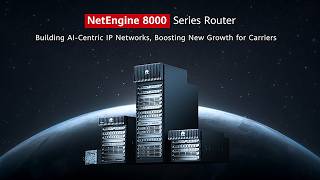
Imagine a router so intelligent that it knows exactly what you are watching or playing to ensure you never experience lag. The Huawei NetEngine 8000 isn’t just a standard piece of hardware; it is a revolutionary AI-centric router designed to manage massive internet traffic while maintaining incredible security. Let’s explore how this technology reshapes our digital world!
The Huawei NetEngine 8000 Series is a pinnacle of modern network engineering, designed specifically to meet the demands of an AI-centric world. As internet traffic grows increasingly complex, traditional routers often struggle to keep up. Huawei addresses this by introducing the industry’s first multi-dimensional traffic-aware board, known as the VSUF-800. This component allows the router to do more than just move data from point A to point B; it actually “understands” the nature of the data it is carrying.
One of the most impressive technical feats of this series is the NetTrans algorithm. In our modern digital landscape, most of the data we send is encrypted to protect our privacy. Usually, this makes it difficult for routers to prioritize important tasks. However, the NetTrans algorithm can identify encrypted traffic with a staggering 95% accuracy. This means the router can tell the difference between a high-stakes live sports broadcast, a competitive gaming session, and a standard office document download. By identifying these different types of traffic, the NetEngine 8000 can ensure that the most time-sensitive data gets the fastest path, providing a seamless user experience.
Beyond just speed, this technology offers significant advantages for service providers through precise user profiling. By utilizing user behavior and experience analysis, companies can see which services are most popular. For instance, if the router detects a household frequently watches 4K football livestreams, the provider can offer a tailored subscription package. This technical insight has been shown to increase upsell opportunities by up to three times, proving that smart hardware can also drive business growth.
Security is another area where the NetEngine 8000 truly shines. It features the TPUI-E, which is the industry’s only intrinsic security board. Unlike older systems that add security as an afterthought, this board integrates protection directly into the hardware. It uses a multi-modal expert algorithm to scan for threats in real-time. This sophisticated system is designed to achieve zero system intrusions, ensuring that services remain “always-on” even when under attack. For a large company or a city’s infrastructure, this level of resilience is absolutely vital.
The “brain” of the router is also incredibly advanced. The MPUB1, or the resilient main processing unit, is another industry first. It utilizes a 40-dimensional knowledge graph to monitor the health of the network. This isn’t just a simple checklist; it is a complex map that understands how different parts of the network interact. This allows the router to detect and prevent “route hijacks”—a dangerous situation where a malicious actor tries to redirect internet traffic to a fake website to steal information. With the NetEngine 8000, the number of successful route hijacks is effectively zero.
We must also talk about the future of encryption: Quantum Key Distribution (QKD). The NetEngine 8000 includes the LPUI-Q, an intrinsic QKD board. This uses the principles of quantum physics to create encryption keys that are virtually impossible to crack. By integrating the encryption and communication networks, Huawei has created a system with zero leaks of user data. This is particularly important for banks, government agencies, and any organization handling sensitive information.
Furthermore, all of these features are designed to be efficient. The NetEngine 8000 can reduce the Total Cost of Ownership (TCO) for carriers by up to 60%. This is achieved through better power management and more efficient data handling, which means companies spend less money on electricity and maintenance while providing a better service to you. It is a win-win situation for both the internet providers and the people using the internet at home.
In summary, the Huawei NetEngine 8000 Series is a masterclass in how AI can be used to make our digital lives better. From its ability to recognize encrypted traffic with the NetTrans algorithm to the futuristic security of the LPUI-Q quantum board, it sets a new standard for what a router can do. For anyone interested in the future of the internet, this series represents a major leap forward. I highly recommend that tech enthusiasts and future network engineers keep a close eye on how AI-centric IP networks continue to evolve, as they are the backbone of our connected future.