
Choosing the right brain for an AI coding agent is like picking the perfect superhero for a mission. It is not just about who hits the hardest, but who is the smartest and most affordable for the job. Let’s explore the OpenHands Index to see which models are winning.
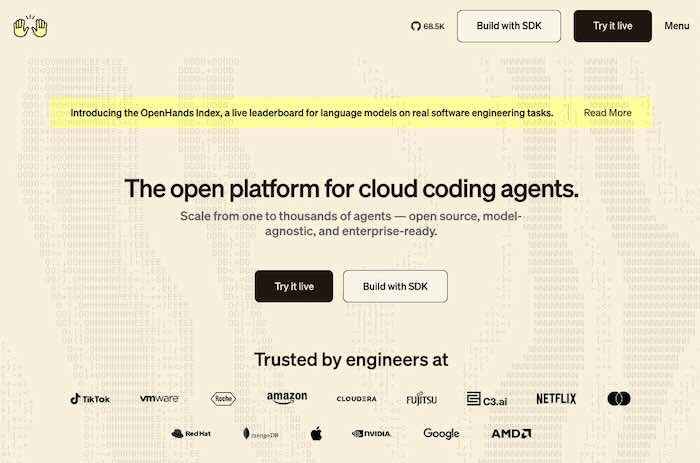
When you are building AI agents for software engineering, you face a very tough choice. You need to decide which Large Language Model (LLM) will actually do the work. It is not enough to just look at basic scores. You need to know how these models handle real coding problems, front-end design, and fixing bugs in production. This is where the OpenHands Index comes in. It is a special leaderboard that tests these AI brains in the real world of software development.
OpenHands started as a community project about two years ago. It began as an open-source tool called OpenDevin, and it was designed to be like a digital coworker for developers. Unlike many closed tools, OpenHands is “model agnostic.” This means you can use it with almost any LLM you want. Because new AI models are released almost every week, the OpenHands team created an index to help people decide which one to use. They don’t just use the famous “SWE-bench,” which only checks if an AI can solve Python issues. Instead, they look at five different areas, including front-end development, software testing, and information gathering.
When we look at the results, there are three main things to consider: accuracy, cost, and time to resolution. Right now, the top performer in terms of accuracy is Claude 3.5 Sonnet from Anthropic. It is incredibly good at understanding complex instructions and finishing tasks quickly. However, there is a catch. Using the most powerful models can be very expensive. If your team is making thousands of “API calls” (which is how the agent talks to the model), the bill can get very high very quickly.
This is why the OpenHands Index uses something called a “Pareto Curve.” Imagine a graph where one side is “how good the model is” and the bottom is “how much it costs.” The models on the curve are the ones that give you the best value. For example, if you want something cheap but still capable, the index recommends MiniMax. MiniMax is an “open weights” model that was recently released. It performs similarly to Claude 3 Sonnet but at about one-tenth of the price! Another great budget option is Gemini 1.5 Flash, which is very fast and doesn’t cost much to run.
We also have to think about the “context window.” Think of this as the AI’s short-term memory. When you are working on a huge software project with thousands of files, the AI needs to remember a lot of information at once. Most modern models designed for coding are trained to have large context windows so they don’t “forget” the beginning of the project while they are working on the end. However, if you want to run these models “locally” (on your own computer instead of the cloud), you need a very powerful machine with a lot of memory. Otherwise, the AI will get slow or stop working entirely.
Another interesting part of the OpenHands research is about “Skills.” In AI terms, skills are like fixed sets of instructions, or “prompts,” that tell the agent exactly how to do a specific task, like upgrading a library or reviewing a Pull Request (PR). Surprisingly, the researchers found that if you don’t design these skills carefully, they can actually make the AI perform worse! It is very important to monitor what the AI is doing using “observability platforms” like Laminar. This helps developers see the actual conversations the agent is having with the model and fix any mistakes in the instructions.
In the future, the biggest challenge for AI agents won’t just be writing code, but “verification.” Right now, generating code is becoming very cheap and easy. But “good code” is still hard to get. We need to make sure the AI isn’t adding “technical debt” (messy code that causes problems later). The OpenHands team is working on ways to automatically test the code using “unit tests” and “static analysis” before a human even looks at it. This ensures that the AI is actually helping the team instead of giving them more work to fix later.
Choosing the right LLM for your coding agent is a balance of performance, price, and the specific task you need to finish. While Claude 3.5 Sonnet might be the king of accuracy today, a cheaper model like MiniMax might be better for repetitive tasks like writing tests. I highly recommend that you visit index.openhands.dev to see the latest data. The world of AI changes fast, so staying updated is the only way to keep your coding agents running at their best. Keep experimenting and happy coding!
Link: https://openhands.dev/